

Here is another great recipe from Chef Jenny Brewer, that uses the winter powerhouse called "Sweet Potato". Chef Jenny will start guest blogging for us in March (2012), with cooking tips and recipes for Tender Foodies of all kinds. I'm very excited to have Chef Jenny lending her expertise!
Prep
Serves 6-8 Preparation Time: 20 mins Cooking time: 35 mins
Ingredients
1 Tablespoon olive oil
1 medium red onion, chopped
1 anaheim pepper, chopped
2 cloves garlic, minced
2 sweet potatoes (1 1/2 lbs),peeled and cut into 1/2-inch cubes
1 28-can whole plum tomatoes
1 cup water or vegetable stock
2 15-ounce cans black beans, drained
1 dried chipotle pepper (smoked jalepeno), seeded and chopped (easiest to do with scissors)
1 teaspoon cumin
1 teaspoon chili powder
1/2 cup chopped fresh cilantro leaves
Recipe
Warm the oil in a large pan over medium heat and add the onion, pepper, garlic, and sweet potato chunks. Saute, stirring often, until onions are soft, about 5 minutes. Add the tomatoes, breaking them up with the back of a wooden spoon. Add water or stock, beans, chipotle, cumin, and chili powder, bring to boil, reduce heat to simmer, cover, and cook for 30 minutes, or until sweet potatoes are tender. Stir in cilantro and serve.
About Chef Jenny Brewer
Jenny Brewer is a nutritionist and chef who believes eating healthy should be easy, delicious and fun! She inspires individuals to stay committed to eating healthy with her free healthy eating resource, Tasty Bites with Chef Jenny available at www.jennybrewer.com.
This is an interview with Cassidy Stockton, the Social Media Specialist for Bob's Red Mill. Through the interview, she takes us behind the scenes at Bob's, and gives us insight into their practices and philosophies, and some of the challenges in the allergen-free food market. The above video opens the door to the plant and their testing facility, so we can see how things are done.
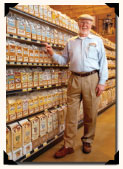
BOB’S STORY
TF: How & Why did Bob’s Red Mill get started?
Bob’s: Bob's journey began in the mid 1960’s after running across a book about old, stone-grinding, flour mills. The book really struck him. He became so enthusiastic, in fact, that he began to search the U.S. for stone mills that were still usable. High-speed, steel, roller mills were quickly dominating the market, so any stone mill was a rare find. Bob is pretty persistant, so when he procured millstones from an old water-powered flour mill in North Carolina , Bob and his wife, Charlee, began their first mill in Redding, California.
In 1978, Bob and Charlee decided to pursue others interests and moved to Oregon City, Oregon. On an afternoon walk, Bob came across yet another, beautiful, old mill. As luck would have it, the mill was for sale. In a few months, Bob was producing stone ground flours and cereals for local customers. Word quickly spread and Bob's Oregon City based mill enjoyed much success until 1988 when a fire destroyed the building.
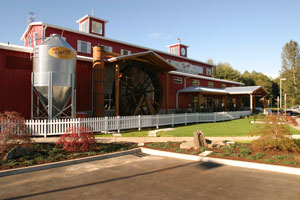
Bob knew he owed it to his family of employees and loyal customers to rebuild. He spent many years growing the business to where we are today. Our current site, located in Milwaukie, Oregon is a 320,000 square foot facility covering some seventeen acres and produces thousands of products each day. Our products are all made with the same good old-fashioned techniques our customers have come to love and trust since our beginning.
ON CROSS CONTAMINATION
Bob's Whole Grain StoreTF: How does Bob’s keep their GF flours truly “gluten-free” when also processing other products that contain gluten grains?
Bob’s: Our gluten free process begins at the farm. We source from suppliers who can deliver clean, gluten free grains. We do not use suppliers who cannot provide us with grains that are mostly clean from gluten-containing grains. Once we receive a shipment, it is tested in our on-site gluten-free laboratory for gluten before it is released into our gluten free facility. If an ingredient does not test gluten-free, it does not go into that facility. All products and ingredients are tested to be under 20 ppm.
Within our buildingwe have two manufacturing facilities- one that is entirely gluten free and one that is for everything else. The gluten free facility has dedicated storage areas, manufacturing lines, employees, and even a separate ventilation system. Customers can learn more, here: http://youtu.be/pAq4pWQHWq4 (links to a tour of our GF facility). All gluten free products are tested when they come in (as ingredients), during and after production before being released to the public.
Our entire facility is HACCP certified, which means that we practice Good Manufacturing Practices and all of our employees are well-versed in preventing cross contact between allergens.
TF: Do you use a particular process for cleaning machines and your facility? If so, why did you choose this particular process?
Bob’s: Yes, we have a full procedure for cleaning machines. All lines are cleaned between runs using air and 30 lbs of the new product is flushed through the system before packaging begins. Production is scheduled with allergens in mind so that cross contact is minimized, for example if a soy product is to be run on a line, only products containing soy are run after it.
TF: What certification organization(s) do you use?
Bob's: We are certified organic by Quality Assurance International and certified kosher by Kehilla Kosher. Our HACCP certification is done by Randolph Associates, Inc.
TF: Do you source your gluten-free grains from farms that do not rotate their gluten-free crops with wheat, rye or barley?
Bob’s: Yes, all of our gluten free oats are grown by a farming cooperative in Canada who is committed to only growing oats. No oats can be grown on those farms within the last 3 years prior to joining the coop. Additionally, while I don’t know the exact mileage, all of those farms are located a certain distance from farms growing wheat/rye/barley or other gluten-containing grains to prevent cross contamination due to weather/ birds/etc.
ON TESTING, LABELING & MULTIPLE ALLERGENS
Bob's Gluten-free LogoTF: To what ppm do you test for gluten? Why have you chosen that particular number?
Bob’s: We test products down to 20 ppm, which means nothing over 19 ppm goes out- period. We chose 20 ppm because we felt that was low enough for the mass majority of people and high enough for us to produce the wide variety of gluten free products that we carry. At the time, this was the standard used in Europe. People should know that while we do test to below 20 ppm, most of our products fall much lower than that.
TF: You also process nut flours. If someone has both gluten and nut allergies, is it safe for a nut-allergic person to eat your gluten-free flours? What is your advice?
Bob’s: Yes, we package hazelnut and almond meal in our gluten free facility. We do not grind these flours, as stone grinding cannot produce flour and instead turns nuts into butters. We do package those flours and as we stated above, use good manufacturing practices to prevent cross contact. We have many people with nut allergies who eat our gluten free products with no problem, but it really comes down to the comfort level of the individual. There are several companies that specialize in allergen-free and nut-free products and we recommend customers look to them if they are not comfortable with our practices.
TF: Do you test for other top allergens?
Bob’s: No, we do not.
TF: Are you considering testing for other allergens to help more people with multiple food allergies?
Bob’s: No, there have been no plans to do so.
TF: Why are some of your gluten-free grains, like whole grain millet, not labeled “gluten-free”?
Bob’s: All of our gluten free grains that are tested, including millet, are labeled gluten free. Some products, such as the millet, are sold to all sorts of customers. Those products have a small symbol on the front of the package to indicate gluten free, while the products that have been specifically designed for gluten free eaters display a more prominent gluten free label. We do have some products that are inherently gluten free, such as Buckwheat Flour and Soy Flour, but are not packaged or tested to be gluten free. This typically happens when we cannot secure a supplier who can provide the commodity in a reliable, gluten free manner in a sufficient quantity for our needs.
TF: Oats are another fairly common allergy for people with gluten allergies or celiac disease. Do you also test for oats in your gluten-free flours?
Bob’s: No.
ON THE PROPOSED GLUTEN TESTING LAW
TF: While on the subject of gluten, what are Bob’s thoughts on the proposed gluten testing & labeling law? Do you think 20 ppm is enough?
Bob’s: As a leader in the gluten free industry, Bob’s Red Mill was asked in the original hearings. We fully support this labeling law and eagerly await its release. We have been very active in pushing this law through by working with our US senator, Ron Wyden. (http://wyden.senate.gov/newsroom/press/release/?id=3d5eb70d-b48a-4afd-8dea-eb2a694df3a5)
We support 20 ppm because we feel it is a reasonable level for most manufacturers to attain. When you start getting into 10 and 5 ppm, many companies won’t be able to meet that threshold and will not be able to produce gluten free foods.
TF: Could you see the law going further in any area?
Bob’s: One area that begs more consideration is regarding the use of the gluten free claim on foods that are inherently gluten free. The spirit of the law is to prevent people from putting gluten free on things such as milk and eggs- things that would not ever have gluten. However, it will cause problems for foods that are inherently gluten free, such as oats, but need to be produced in a way that makes them fully gluten free. It does not help the consumer to say that all oats are gluten free- they simply are not.
TF: Could you clarify what the labeling law means for foods that are "inherently" gluten-free?
Bob's: It’s kind of a tricky wording on the proposed law. It says that if a product is inherently gluten free, you must state that. So for things like Quinoa, for example, even if we go above and beyond to ensure that the product is gluten free (through sourcing, production, and testing), we’ll have to put “quinoa is inherently gluten free” on the labeling if we want to call it gluten free. What worries our company is that people might assume that all quinoa is safe for consumption because it’s "inherently gluten free", (when it could be sourced or processed with gluten grains, and is not tested for gluten). That’s just an example, by the way. It’s just scary with the foods that really do have a high chance of cross contact- like oats- and if customers are not as savvy about what something like "gluten free oats" really means, they might think that all oats are inherently gluten free, so safe to eat even if the label doesn't actually say "gluten free".
TF: What is the most difficult thing for food manufacturers to deal with when serving people with food allergies (Tender Foodies)?
Bob’s: Cross contact and keeping our ingredients clean through the entire process. It’s hard when you’re trying to source grains and your suppliers don’t know enough about allergens to work with you.
ON AUTISM & HEALTH
TF: I see on your web site that Bob is a big supporter of health and wellness. In fact, he and his wife recently gave to Oregon Health and Science University. What inspired this interest and the gift to OHSU?
Bob’s: The donation to OHSU and the two given last year to Oregon State University and the National College of Natural Medicine are all working to create and bolster nutrition research and education. The OHSU donation is the largest and will create the Moore Family Center for Whole Grain Foods, Nutrition and Preventive Health. Bob and Charlee want nothing more than to help end childhood obesity and educate people about proper nutrition.
TF: I also noticed that Bob’s site has a section dedicated to Autism. I know that a gluten-free diet has helped many people with Autism. What is Bob’s interest in this condition?
Bob’s: Our gluten free products have always been free from dairy/casein and we started hearing from our customers about their success following a GF/CF diet to mitigate the symptoms of autism. We care about our customers, so we listened and started trying to get more involved in the autism community.
TF: Do you have any new products coming to market, or any events coming up that you would like my readers to know about?
Bob’s: We have a few new gluten free products coming in 2012, but we cannot divulge what they are at this time.
ON GENETICALLY MODIFIED ORGANISMS (GMO’S)
TF: What is your position on GMO's?
Bob’s: All of our products come from identity preserved seeds. This means the seed planted in the ground is non-GMO. We simply can't guarantee against cross-pollination due to natural occurrences such as wind drift, so we do not label our products GMO-free.
BOB’S ADVICE FOR TENDER FOODIES
TF: How can Tender Foodies help manufacturers serve them better?
Bob’s: By increasing education and awareness (in the community).
TF: If you were to give the Tender Foodie Community one piece of advice, what would you like them to know?
Bob’s: Be an advocate for yourself. You are your biggest ally in eating allergen-free.
My warmest thanks to Cassidy Stockton and to Bob's Red Mill for the information they provided for this interview.
Nearly every week, I visit several grocery stores just to buy the staples that I need. If you have multiple food allergies and intolerances, finding the most basic products in one place is nearly impossible. If you live in a mixed-allergy/non-allergy household, whew, you are probably too tired to actually make dinner! As I listen to the Tender Foodie Community, it's clear that most of you experience the same huffing and puffing and trucking around town. You might have to drive across state lines. Perhaps you also order from multiple internet stores.
Wouldn't it be nice if we could just go to one or two stores to get what we need? Here's the kicker: The individual nature of mutlipe food allergies (along with your personal tastes) make it tough for grocery stores and brands to know what you need. Unless, of course, you tell them. If we tell them en masse as a Tender Foodie Community, your request has more influence.
To help get your needs to your local grocers (and to the brands that they sell), I've put together a form. Here's how it works:
1. Sign up to become an email member in order to access this form. Its free and we only send out updates once or twice a month. Becoming a member will help us reduce the amount of spammers hitting our form.
2. Log in to access the form whenever you find your head about to explode because you can't find X product, or you wished that you could find, for example, a cocoa powder that is non-GMO, non-alkaline, and produced in a factory that does not also process other allergens.
3. Twice a month, I'll send your request along with others in your community to your local grocer. Where appropriate, I'll also send the request to whatever brands you list.
4. The more requests for a particular product that a grocer receives and the more requests the brand receives for better allergen processing, the more likely our community will benefit. So ...
5. Send this blog post to every Tender Foodie that you know.
As a community, we are used to taking our knocks, doing our homework, and being silent. If we have a way to act as a community, who knows, vendors might be swayed to work with allergen-free suppliers, test for multiple allergens, or make their facilities free of multiple allergens. It could happen (here is one example). Plus, you might reduce the number of trips you make, the amount of gas you burn and the amount of postage you drop. Though we can't guarantee any vendor's actions, we think this could be super powerful.
Your input could help greatly expand the "safe" choices out there for Tender Foodies.
Does this Happen to You?
For example, I tend to visit the Meijer store near me for "some" organic vegetables, especially greens like kale and swiss chard. They sometimes have the dairy-free chocolate chips that I use and sometimes have one of the many gluten-free flours that I use. I go to one Harvest Health in Hudsonville to get the only truly dairy-free plain yogurt, that isn't processed in a factory that also produces other things I can't eat, even though their location on Burton Street is more "on my way" and both carry many allergen-free staples that I use. I just gave a jingle to Saffrons, a Gluten-free Marketplace to see if they carried whole grain millet that isnt processed in a cross-contaminated factory, they didn't, but they were happy to get in a case for me. Saffron's really does their multiple allergy homework. They review products regularly, and label them for multiple allergens so it saves you shopping (and homework) time. Although Saffron's is not conveniently located to me, I will drive there to get it and whatever else I can find, since they have great stuff. For grassfed meats, I just made my first visit to Nourish Organic Market. Nourish carries local and grassfed meat from local farms and butchers and other great products. Plus, they are next to my yoga studio (From the Heart). To try to add some measure of convenience, I now order local and organically raised vegetables from Doorganics - who delivers right to my door every Wednesday afternoon. They are another new business that, although you can't yet order what you want in your weekly box (she says hopefully), they are helping me to expand my palate and try stuff I don't usually get (like turnips, which I now love). Plus, their produce is straight from the farm keeping their fruits and veggies packed with the most nutrients. I've also gone to Horrock's Market to get the Nature Made Frozen Fruit that I use in my smoothies. For my favorite chocolate of all (Callebaut), and for organic wine I make an occasional trip to G.B Russo's and Son. They have great, higher end, specialty cooking supplies, too. I used to visit the D&W Fresh Market near me because they were expanding their organic produce and allergen-free items. However, it is now a Family Fare and they discontinued some of the items that I counted upon. Several compoundingly disappointing trips later, I stopped trying. I bet if they knew that, and other people spoke up, they would rethink what they are putting on and taking off the shelves. Did I mention Trillium Haven Farms at the Fulton Street Farmer's Market in the summer? Or trucking through Costco for items that might or might not be there from week to week? Then there are the online stores, the internet searching, the cross-contamination research...
A Post by Audrey Depenbrook, Guest Blogger (Thanks, Audrey!!)
As a Tender Foodie, with a severe dairy allergy, I’m always looking for ways to add that dairy-like richness to my food.
It’s been 9 years since any form of cow’s milk has touched my lips intentionally. If I had to pick something that I missed the most, you might expect me to say “cheese” or “ice cream”. However, something I missed the most was butter. Salty, creamy, delicious butter.
Think about it, butter has countless uses in the kitchen - it’s not just a condiment. It’s used endlessly in baking, we spread it on our toast and bagels, we use it to make a rue to thicken a sauce and much more.
Thankfully, the awareness of food allergens has been a higher priority of food manufacturers lately and there are many options for dairy free butter. I’ve found two that I love - and they’ve earned a permanent place in my refrigerator.
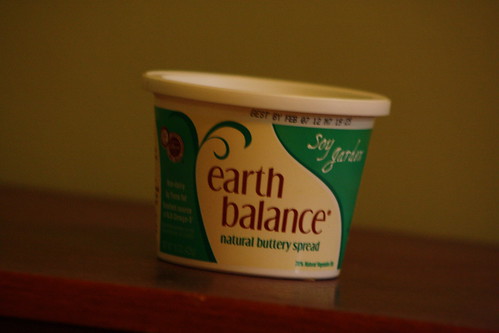
Earth Balance - Soy Garden
First up. Soy Garden - Earth Balance Natural Buttery Spread. It has a wonderful creamy texture, with just the right amount of saltiness. It’s a perfect everyday spread. I use this mainly on toast, on veggies and in sauces. It melts beautifully. I have even used it on popcorn, and made a clarified butter out of it. I also love using this spread in one of my favorite go-to quick meals, dairy-free macaroni and cheese (I’ll tell you all about that some other day).
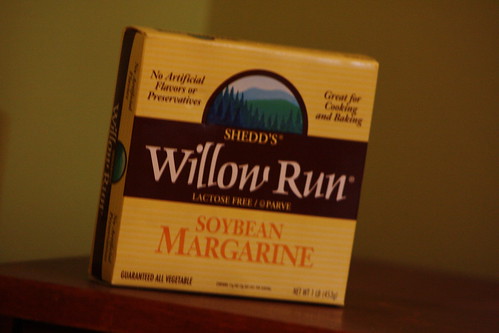
Shed's Willow Run Margarine Sticks
When it comes to baking, I have another favorite. Shedd’s Willow Run Margarine Sticks. Because this product comes in sticks it’s much easier to measure than a spread that comes in a tub. Earth Balance makes their spread in a stick variety, but it doesn't seem to work as well in baking, it lacks the richness that Willow Run has. I’ve found that Willow Run sticks work as a great substitute for both butter and margarine and they haven’t failed me yet in any baking experiments.
Both manufactures have done a wonderful job in eliminating the “soy aftertaste” that so frequently accompanies many dairy-free products. They have also both labeled their products well - making it very clear which allergens the product contains and which allergens have been avoided.
If you’re a Tender Foodie that has to avoid milk due to an allergy or intolerance, go ahead and pick up either of these products and indulge yourself in the deliciousness of butter.
Earth Balance and Willow Run spreads can both be found in store at Meijer and at Wegeman's.
PLEASE NOTE: Since the labeling on these products expresses that they are "non-dairy", but not expressly "dairy-free", we have a requested more information about the factory practices from Earth Balance and Shedd's Willow Run. We will post any information that we receive.
Just got a very nice response from Earth Balance about its processing practices. Here it is:
Dear Elisabeth,
First, please accept our apologies for the delay in responding to your recent email. Thank you for taking the time to contact us here at Earth Balance. We always appreciate hearing from consumers who care enough to reach out to us with their comments or questions.
All Earth Balance® products are dairy-free, gluten-free, lactose-free and vegan. All of our products are produced in gluten free facilities.
We do manufacture in facilities that also produce spreads that contain dairy; however, our manufacturing lines are cleaned and sterilized prior to non-dairy product production since we have parve certification.
Thank you for supporting Earth Balance® products. We hope you continue to enjoy our products for many years to come!
This past Saturday, I walked into the Delta Plex after hearing that 1565 people registered to attend the Gluten-Free Food Fair that day.
If someone had told me 5 years ago, that this many peops would be attending a gluten-free anything, I would have been shocked. But because the number of folks struggling to implement an allergen-free diets has exploded in the last few years, the crowds were more of a bittersweet confirmation. The potential whys and wherefores of this explosion are just starting to be truly studied and discussed.More on that in another post.
King Arthur Flour's Brownie Mix and a Couple of Nice Peops.
Multiple Food Allergies Need More Know-How
At the fair I witnessed that the market is also attempting to serve the millions who have multiple food allergies, yours truly included. There is a long way to go in shared knowledge about multiple and more complex food allergies, which I predict, sadly, will also rise in the near future. Many of the vendors at the booths were also the brains behind the product, the owners of the company, the big Kahunas. They were the most knowledgeable about the factories, their partners and the ingredients. There were a handful at the booths, however, that would confidently say things like, "All ingredients were processed in a factory free of the "Big 8" allergens (free of corn, wheat/gluten, dairy, soy, eggs, peanuts, treenuts, shellfish/seafood & fish)," even though the labeling on the products themselves said differently. Also, one or two other vendors couldn't break down a few mystery ingredients listed their products. Most everyone was just fantastically knowledgeable, however, and brought their own experience to the table. I hope that all vendors will continue to be and learn ahead of this growing market, and also train their staff with an emphasis on ingredient and factory knowledge. There is a great deal to learn for all of us.
Cool Products
I did find some interesting new products, some of which I'm going to try. I'll tell you about them over the next few weeks as I do. If you would like to try them as well, let me know what you think! In the meantime, here is a quick list.
Allerbling: I love this product. It is hard enough for adults to communicate about their food allergies. Imagine what it is like for a kid? I can't. But this product could really help. Just stick out your wrist, kiddo and let your teachers, your friends' parents have an immediate list of what you can't eat. It's a cute little bracelet with interchangeable parts that represent even some of the more uncommon allergies as well as the Big 8.
Somewhat Organic Soap: I have to say that their slogan, "Any more organic and we'd be lying to you,' caught my attention. From what I understood, lye is the only non-organic ingredient in the soap. What I liked about them is that they have a Simple Soap that they said has zero fragrance. It does contain coconut and rosemary extract, however, so it isn't quite as simple as super senstive people might need, but the vendors did say that super sensitive kids really liked it. Your call. Their other soaps with essential oil fragrance were lovely and felt great.
1-2-3 Gluten-Free: Along with gluten and dairy, I am also allergic to baker's yeast. So I simply don't eat sandwiches or biscuits any more. I picked up a package of the 1-2-3 biscuit mix because it is free of all of the Big-8 allergens, and it is also yeast-free. I'm excited to try this.
Keeki Pure & Simple: A gluten-free nail polish developed first for celiac kids who might chew their nails, it is also "suitable for vegans" and for adults. Fun colors.
Organic Bistro Entrees & Bowls: These conscientious folks were offering a taste of different products throughout the day. Most of the ingredients in the Thai Style Yellow Curry with Chicken that I tried were, indeed, organic. It was delicious. A great quick meal alternative when you don't have the time to put together a lunch.
Mrs. Glee's Noodles: A quick cook noodle made from navy beans and non-GMO corn. It is also fortified with some of the vitamins and minerals that Tender Foodies tend to lack, like B Vitamins, Folic Acid, and Iron; as well as natural protein from the "ungassed" beans.
The brains behind Mrs. Glee's
Restaurants Serving Gluten-Free
I was excited to find out that The Blue Water Grill has a dedicated gluten-free fryer, so you can get your french fries without cross contamination. Brann's also was there serving sweet potato fries from their dedicated gluten-free fryer. I was pleasantly surprised to find Vitale's serving up gluten-free pizza, with pizza crusts from Coco Charlotte, a local-to-Grand Rapids gluten-free baker. Willy O's, however, was serving up a gluten-free, yeast-free and dairy-free veggie pizza. It was thin and crispy and pretty good. It set off a few pleasure bells in my head since I haven't had any kind of pizza in years I will have to try it again when its fresh from the oven and without broccoli (not a big broccoli fan).
Saffron's Marketplace was also there and they have a great little exclusively gluten-free shop. I stopped by there after the fair to check out the rice cheese and daiya cheese which was whispered about throughout the fair-goers as great dairy alternatives. But alas, this favorite will remain a mystery to me as it contains inactive yeast.
Your server rep from Vitales and a few gluten-free options including beer and pasta
Vitale's gluten-free pizza went like hotcakes and got rave reviews
Nutritional Learning Curves
I was disappointed that I couldnt' get there in time to see Marie Catrib's demonstration of gluten-free bread making. But I was able to catch Heather Leets, RD Dietician with Spartan Stores. Heather discussed that rice, potatos and corn are the most common replacements for wheat, however, their starch content is high, as is the potential for weight gain if you turn to these exclusively.
Heather then reviewed some of her favorite protein-rich, low-starch, high-nutrition flours. These flours are my favorites as well and include teff flour, quinoa, buckwheat, millet, amaranth and a new flour to me - sorghum. I experienced sorghum flour for the first time last week as I took the plunge and had a beer after 10 long years. Gluten-free of course. One interesting point Heather made, was that people with celiac disease (and I'd like to add any food allergy to that) can have a tougher time absorbing nutrition. Whole grains like these are rich in protein, soluble and insoluble fiber, B Vitamins and minerals like iron, magnesium and selenium. Amaranth, for instance has 3 times the fiber of wheat! Personally, I feel a remarkable difference when these grains are part of my daily diet.
I am also happy to have learned a little more about each of these vendors at a great event.
Thanks to the Celiac Ministries of Anchor Baptist Church for putting on this very successful fair! Stay tuned for a Q&A with Nancy Spears, the mastermind behind the event.